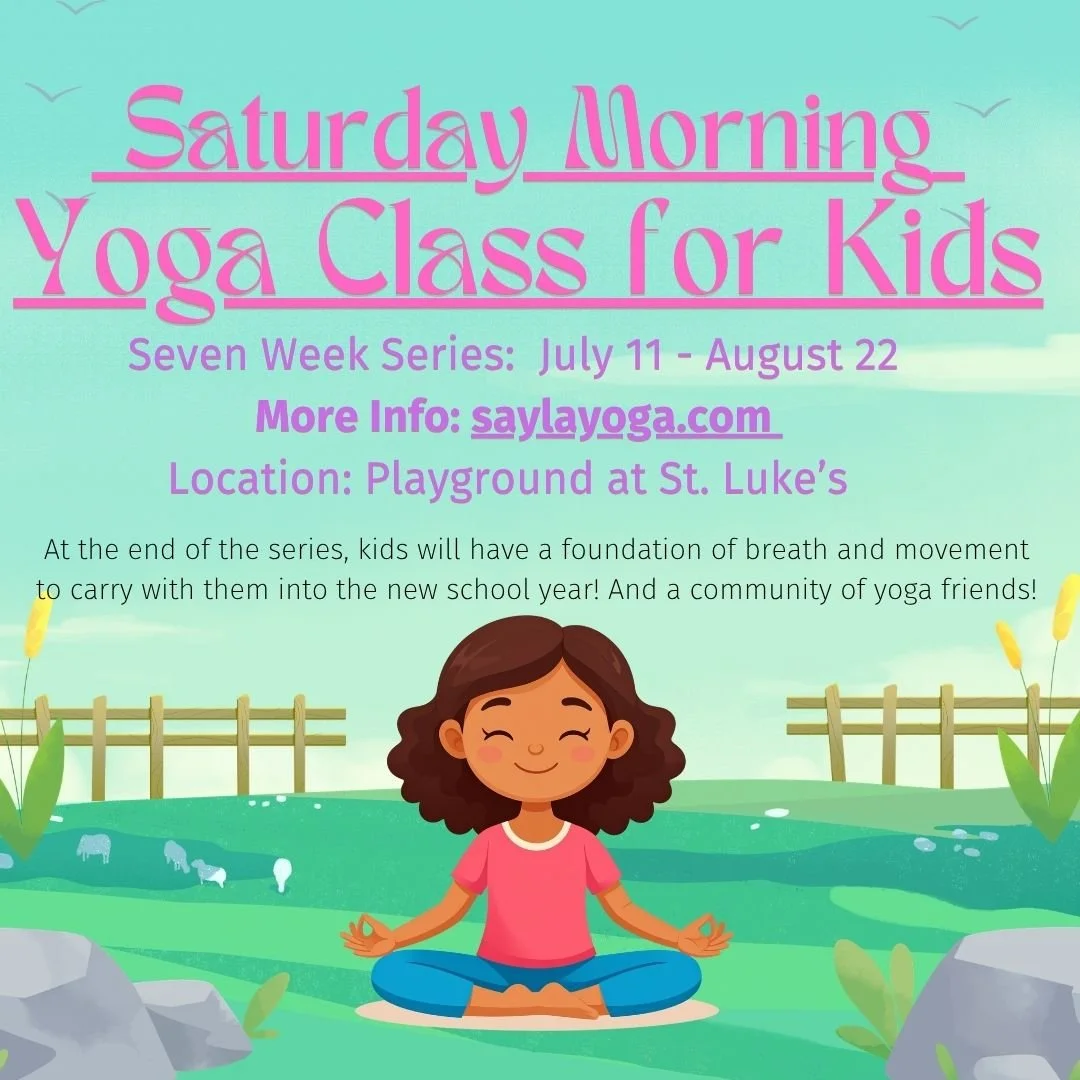
The Benefits of Yoga for Kids: Join Yoga Series on July 11 or Drop In for Class Until Aug 22
I have been playing more and more with AI, using as a starting pad for thoughts, to ask questions and explore the resources provided. (And let’s be honest to reword content when I know someone else can say it even better!) As I am prepping to launch a kids yoga class in July, I have been checking books out from the library and looking over studies about the benefits of yoga for kids. Naturally, I went to Chat GPT to ask about the benefits to see what was returned. My prompt was “What are the benefits of yoga for kids based on scientific studies. Includes sources.” I made some updates and added sources for the facts.
If you are interested in kids yoga in July. Start here. I have the class sketched out, but want to finalize based on the interested kids. First class is Saturday, July 11! Space is limited for the series; more details are below.
If you want to know why you should sign your kiddo up, keep reading.
Children today face increasing levels of stress, screen exposure, academic pressure, and emotional challenges. As parents and educators search for healthy ways to support children’s development, yoga has gained attention as a research-supported practice that benefits both physical and mental well-being.
Yoga combines movement, breathing exercises, mindfulness, and relaxation techniques—all of which can positively affect children’s cognitive, emotional, and physical health.Recent scientific studies suggest that yoga may improve attention, reduce anxiety, strengthen emotional regulation, and support overall wellness in children and adolescents.
Improved Attention and Focus
One of the most researched benefits of yoga for children is its effect on attention and executive functioning.
A 2019 school-based study highlighted by the National Center for Complementary and Integrative Health (NCCIH) found that kindergarten students practicing yoga twice weekly showed reduced inattention and hyperactivity compared to peers participating in regular physical education.
A 2024 meta-analysis examining yoga programs in children aged 3–7 also found small but meaningful improvements in executive functioning skills such as working memory and inhibitory control.
Reduced Anxiety and Stress
Yoga’s breathing and mindfulness practices may help children better regulate stress and anxiety.
An integrative review published in Journal of Psychiatric Research analyzed more than 1,000 children and adolescents across multiple studies and concluded that yoga interventions consistently improved psychiatric symptoms, relaxation, emotional regulation, and overall well-being.
Researchers suggest that yoga may help activate the parasympathetic nervous system—the body’s “rest and digest” response—which supports calmer emotional states and stress recovery.
Better Emotional Regulation and Behavior
Yoga encourages mindfulness and self-awareness, which can help children better understand and manage their emotions.
According to the American Academy of Pediatrics (AAP) guidance referenced by NCCIH, yoga may help children develop self-regulation skills, improve focus, and handle challenges more peacefully.
These emotional regulation skills can be especially valuable during childhood and adolescence, when social and emotional development is rapidly evolving.
Enhanced Cognitive Performance
Several studies indicate that yoga may positively influence memory, executive functioning, and academic-related cognitive skills.
The 2022 randomized controlled trial involving female students with lower academic performance found that yoga improved executive functioning and intelligence measures while lowering anxiety.
Additionally, a study published in International Journal of Yoga reported that yoga-based relaxation techniques produced immediate improvements in children’s attention performance.
Researchers believe the combination of mindful breathing, movement coordination, and sustained attention during yoga practice may strengthen cognitive processing and concentration.
Physical Health Benefits
Beyond mental wellness, yoga also supports healthy physical development in children.
Research suggests that yoga can improve:
Flexibility
Balance and coordination
Muscular strength
Posture
Body awareness
Unlike highly competitive sports, yoga offers a non-competitive environment where children can participate at their own pace, making it accessible for a wide range of personalities and fitness levels.
Improved Sleep and Relaxation
Healthy sleep is essential for children’s growth, emotional stability, and cognitive development. Emerging research suggests mindfulness and yoga-based practices may support better sleep quality.
A Stanford University study discussed in scientific forums found that children who learned mindfulness, breathing, and yoga techniques experienced longer and higher-quality sleep over time.
While more large-scale studies are still needed, researchers increasingly recognize the connection between relaxation practices, stress reduction, and improved sleep outcomes in children.
Final Thoughts
Scientific research continues to support yoga as a valuable complementary practice for children’s physical, emotional, and cognitive well-being. From improving attention and reducing anxiety to promoting better sleep and emotional balance, yoga offers children practical tools they can use throughout life.
In fact, Yoga Alliance has played an active advocacy role in expanding access to yoga for children in public schools across the United States, including their support for Alabama House Bill 246, allowing Alabama public schools to offer yoga as an elective activity for K–12 students. Yoga Alliance continues to monitor and support legislative and regulatory efforts nationwide that protect access to yoga instruction and promote the inclusion of yoga and mindfulness practices in educational settings, including in Illinois where Governor J.B. Pritzker signed SB 2872 allowing at least 20 minutes of “relaxation activities” during the school week. Read more here from the Balanced Child.
As schools, parents, and healthcare professionals increasingly recognize these benefits, yoga is becoming an important part of modern whole child wellness programs.
Summer Yoga Series for Kids!
I am launching a Saturday morning kids' series, starting Saturday, July 11 and ending on Saturday, August 22. The 90-minute small-group am class will include yoga, breath work, snack meditation, a story and play at the St. Luke’s (at Ft. Hunt and Wellington) playground or in a classroom - pending heat or rain.
Each grown-up must have a kid! (Depending on interest over the first few classes we may split to two groups based on ages and add another class starting with open play at 9:30-10 and the second class for older kids starting at 10am. Stay tuned.) Adults are asked to engage in class and participate with each child per class. No drop offs.
You (and your child/ children) will need a yoga or pilates mat or beach towel per participant. I will supply the rest.
At the end of the series, kids will have a foundation of breath and movement to carry with them into the new school year! And a community of yoga friends!
Details:
WHERE: St. Luke’s Playground (Indoor playroom if raining or too hot) at 8009 Fort Hunt Road
WHAT: BYOM (bring your own mat) to Yoga for kids (no drop offs, one adult must join kids for the full program) Open to ages 4-9, please email if your child is interested and not inside this range.
WHEN: 8:30am to 10am on Saturdays (July 11- August 22)
Three things needed to join:
Complete the intake formahead of class if possible. Your feedback will help shape activities and help me to get to know your child;
Complete this liability waiver per participant MUST have ahead of class; and,
Suggested donation here $120 per child for the full 7-week series ahead of class. (or cash, check or Venmo also available in-person). Or donate here $20 per child per class ahead of class. (or cash, check or Venmo also available in-person). We will finish payment housekeeping after class. (Cost is split 50/50 with St. Luke’s)
Thank you for your interest! Please email with any questions.